
Optimism about a stable govt at the Centre, a demand revival and falling oil prices buoyed the markets.

The rupee extended its losses and slumped 60 paise to close at a record low of 77.50 (provisional) against the US dollar on Monday, pressured by the strength of the American currency overseas and unabated foreign fund outflows. Forex traders said risk appetite has weakened amid mounting concerns about inflation that may trigger more aggressive rate hikes by global central banks. At the interbank foreign exchange market, the rupee opened lower at 77.17 against the greenback, and finally settled for the day at 77.50, down 60 paise over its previous close.

Led by Tata Motors and Tata Consultancy Services (TCS), the combined revenue of the Tata group's listed firms crossed the Rs 10-trillion mark for the first time, in 2022-23. The group's 14 key listed companies in which Tata Sons holds a direct equity stake reported a combined revenue of Rs 10.07 trillion in FY23, up 15.3 per cent from Rs 8.73 trillion in FY22. The combined net profit of these companies was, however, down 10.6 per cent year-on-year (YoY) at Rs 66,670 crore in FY23, from a record high of Rs 74,540 crore in the previous financial year, when the profit had jumped 156 per cent YoY, aided by Tata Steel's strong showing.

Wadia Group-owned Go First Airways' (Go First) insolvency plea could trigger a 'momentum rally' in shares of rival airlines, Interglobe Aviation (parent company of IndiGo) and SpiceJet, as they look to gain bankrupt airline's market share, said analysts. On the bourses, shares of InterGlobe Aviation hit a 52-week high of Rs 2,235.95, surging 8 per cent on the BSE in Wednesday's intra-day trade, before settling 4.5 per cent higher at Rs 2,164 apiece. Those of SpiceJet and Jet Airways, meanwhile, rallied up to 6 per cent in the intra-day trade, and ended 1 per cent and 5 per cent higher, respectively, following the development, which was announced post market hours on Tuesday.

Investments through participatory notes (P-notes) in the Indian capital market surged to Rs 78,686 crore at October-end, making it the highest level in 14 months, on enhanced global liquidity and measures taken by the government back home. P-notes are issued by registered foreign portfolio investors (FPIs) to overseas investors who wish to be part of the Indian stock market without registering themselves directly. They, however, need to go through a due diligence process.

Listed companies have seen equity deals worth Rs 23,500 crore in March.
The value of P-note investments in Indian markets - equity, debt, hybrid securities and derivatives - stood at Rs 74,027 crore till August-end.
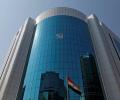
The regulator typically meets overseas investors in the US and UK in the first half of a financial year, and had opted for a virtual meet last year too.

HSBC maintained "overweight" rating on Indian equities, saying "fundamentals are strong".

The amount of loans that carry a high risk of slippage into the NPA category over the next few quarters is about Rs 2.8 trillion.

Macroeconomic data announcement, Omicron situation and global trends will be the major driving factors for the equity market in the first week of the new year 2022, according to analysts. In what turned out to be a historic year, the Indian stock indices went past multiple milestones and the 30-share Sensex made an annual gain of 10,502.49 points or 21.99 per cent in 2021. Religare Broking Vice-President (Research) Ajit Mishra said, "This week marks the beginning of a new month and participants will be closely eyeing some crucial high-frequency data like monthly auto sales, India manufacturing PMI and India services PMI. "Besides, updates on the COVID-19 situation and performance of global markets will also be critical."

For large start-ups the US market is considered to be a preferred destination, as Indian investors were seen as hesitant to pay the kind of valuation private equity investors or the US markets pay. However, Zomato's listing has quashed these notions.

FIIs pump in Rs 2,075 crore in past three trading sessions.

The trade-war between the US and China is prompting investors to flee from risky assets, such as equities, to safe-haven bets, such as gold and treasuries

Covid-19, US yields, dollar to weigh on equity flows in the near term.

The fundamental debate remains where you stand on the long-term growth question. That is what every investor must monitor and come to their own conclusions, suggests Akash Prakash.

According to the latest data released by the Securities and Exchange Board of India, the total value of P-Note investments in Indian markets (equity, debt and derivatives) rose to Rs 1,72,738 crore (Rs 1,727.38 billion) at the end of February from Rs 1,63,348 crore (Rs 1,633.48 billion) in the preceding month.

Bajaj Finance was the top gainer in the Sensex pack, rising around 11 per cent, followed by Titan, Tata Steel, SBI, M&M, HDFC, IndusInd Bank and Reliance Industries. On the other hand, Sun Pharma, Nestle India and UltraTech Cement were among the laggards.

Indian rupee is likely to test 76-76.50 levels as a relatively strong greenback, boiling crude prices and COVID headwinds deepen the depreciation bias for the domestic currency, according to experts. One of the significantly-hit Asian currency in recent months amid uncertain economic times, rupee is expected to see a consolidation in the vicinity of the current level before being pulled towards the depreciation bias. While the equity market has been surging with occasional blips, the rupee has mostly been weak against the US dollar in recent months.

Inflation data and global trends would be the major driving factors for the equity markets this week which after a record-breaking run took a breather in recent trades, analysts said. The overall market sentiment remains positive, supported by improving economic data and earnings but higher valuations can trigger bouts of profit booking, they said further. During the last week, which the 30-share BSE benchmark rose by 175.12 points or 0.30 per cent.

HDFC was the top gainer in the Sensex pack, rallying over 7 per cent, followed by HCL Tech, M&M, HDFC Bank, Tata Steel, SBI, Bajaj Finance and Infosys. On the other hand, Axis Bank, Asian Paints, HUL, Titan and IndusInd Bank were among the laggards.

'For the next two years, we expect the bulk of earnings growth contribution from sectors like financials and energy, where the outlook remains positive, while the sectors which are linked to domestic consumption and are currently witnessing strains on margins have low salience for Nifty earnings.'

L&T was the top gainer in the Sensex pack, rising over 3 per cent, followed by Bajaj Finance, Reliance Industries, IndusInd Bank, SBI and HDFC Bank. NSE Nifty surged 168.05 points to 14,653.05.

India's equity markets are on a roller-coaster ride, after delivering spectacular returns for two consecutive years - in 2020 and 2021. The benchmark National Stock Exchange's (NSE's) Nifty50 is down 1.5 per cent in the first nine months of the current calendar year 2022 (CY22) as foreign portfolio investors sold Indian stocks due to rising bond yields in the US and across global markets, including India. The sell-off in the Indian equity markets has, however, not been broad-based and largely limited to sectors facing earnings headwinds from rising interest rates, lower commodity and energy prices, and likely economic recession in advanced economies.

IndusInd Bank was the top gainer in the Sensex pack, rallying over 6 per cent, ahead of its earnings announcement. Axis Bank, Kotak Bank, ICICI Bank and Bajaj Finance too surged up to 5 per cent. On the other hand, NTPC, M&M, HDFC Bank, Bharti Airtel and ITC were the laggards.

Kotak Bank was the top gainer in the Sensex pack, rallying over 8 per cent, followed by TCS, Infosys, ICICI Bank, HCL Tech and ONGC. On the other hand, Titan, HUL, PowerGrid, NTPC and Nestle India were among the laggards. NSE Nifty advanced 126.60 points, or 1.38 per cent, to settle at 9,313.90.

This compares poorly to other developed markets as the average wealth of a person in Australia has increased by over 100 per cent and in Canada by over 50 per cent in the same period.

The likelihood is that India will maintain a moderately upbeat economic tempo -- well short of tearaway growth, explains T N Ninan.

According to media reports, Securities and Exchange Board of India is debating whether to reopen the issue of an open offer for shareholders of Jet Airways after another regulator said that Etihad enjoys joint control over the Indian airline.

Sustained foreign fund inflows and strengthening rupee are among the main reasons behind the market rally.

Despite strong AUM growth, MFs lag behind other popular investment avenues. MFs received only 6 per cent of total household savings in 2021-2022.

It has mostly been a one-way street for markets that have moved up sharply since July. The front-line indices - the S&P BSE Sensex and the Nifty50 - have gained 6.7 per cent and 7.3 per cent, respectively, in the past three months. The rally in mid- and small-caps has been sharper, with both indices surging 14 per cent and 9 per cent, respectively, during this period. This sharp run has made analysts at Jefferies cautious.

Indian stock markets on Thursday witnessed a record daily turnover of over Rs 5 lakh crore, even as the benchmark Sensex missed its all-time intra-day high by a whisker.

Since October, FPIs have sold over $26 billion worth of stocks, which is the largest selling ever seen in India, observes Akash Prakash.
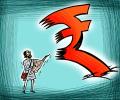
The rupee appreciated 7 paise to 79.74 against the US dollar in early trade on Thursday as a positive trend in domestic equities supported the local unit. However, a strong American currency overseas and forex outflows restricted the rupee's gain, dealers said. At the interbank foreign exchange, the rupee opened at 79.72 against the American dollar, then went lower to trade at 79.74 against the greenback in early deals, registering a gain of 7 paise over the last close.

Foreign investors have pumped in a staggering Rs 98,802 crore or Rs 988.02 billion.

'There is no need to do anything, let your SIPs get deducted every month, and stick to your allocation between equity, fixed income and emergency funds and your risk covers.'

Mahindra and Mahindra was the top gainer in the Sensex pack, surging over 16 per cent, followed by Maruti, Titan, Bajaj Finance, HDFC, Bajaj Auto and Hero MotoCorp. On the other hand, HUL, Tech Mahindra, IndusInd Bank and Nestle were the laggards.

'If India can only grow at 5%, why bother spending time on the country?' asks Akash Prakash.
There seems to be no dearth of funds to fuel this growth, report Peerzada Abrar and Shivani Shinde.
